The SGUSVM program offers students a unique, innovative, international approach to veterinary medicine. Great emphasis is placed upon clinical instruction as a method of formulating the basic science curriculum into clinical practice with the use of simulation models, case-based teaching, and outstanding student-to-faculty ratios. With state-ofthe-art teaching and laboratory facilities, students receive exemplary experiences in preparation for clinical training rotations and for general veterinary practice following graduation. Students receive extensive opportunities designed to foster the understanding and confidence required for success as veterinary professionals, including research, practice management and responsibilities of veterinarians to local and global public health.
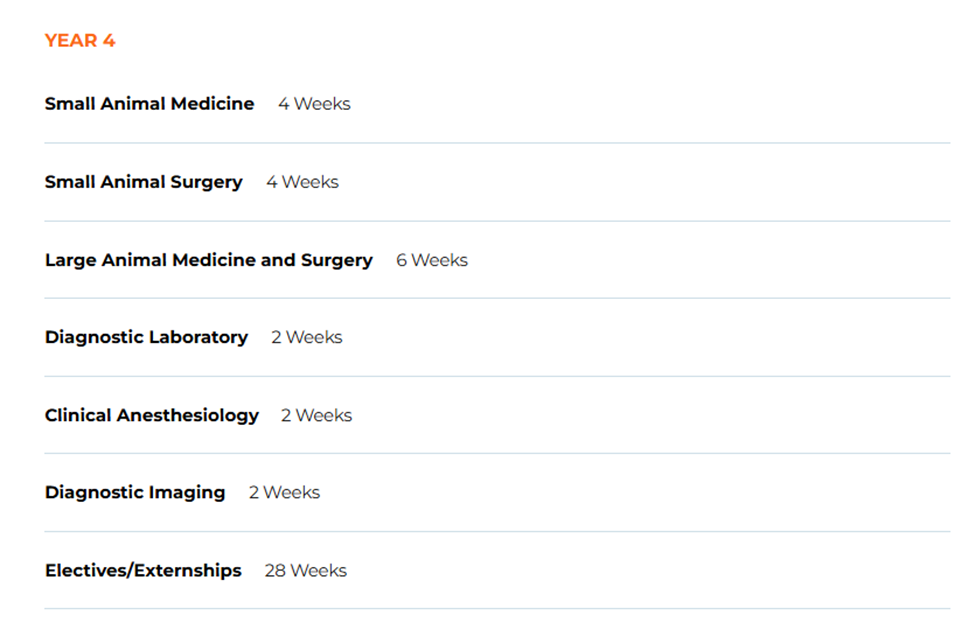
The SGUSVM program offers three years of didactic coursework in basic sciences, public health, and introductory clinical work in large and small animal medicine and surgery in Grenada, followed by a fourth year of clinical training. The final year is 48 weeks of clinical training made up of 20 weeks of instruction in six core subjects, and 28 weeks of electives that may be a continuation of core subjects or concentrations in select specialties. We are affiliated with 32 schools of veterinary medicine. Twenty-five of these affiliated schools are in the United States, two are in the United Kingdom, two are in Canada, one is in the Republic of Ireland, one is in Australia, and one is in the Netherlands. SGU students spend their final clinical year alongside students enrolled in those institutions. The SGUSVM model of education is proven to be a successful veterinary education model through outcomes assessments of students training in the foundation curriculum at SGU, in the fourth-year clinical rotations at our AVMA-accredited affiliate schools, and as successful veterinary practitioners.
The Doctor of Veterinary Medicine (DVM) curriculum at St. George's University is structured into six terms located in Grenada, followed by a clinical 4th year at affiliated clinical sites. Each term consists of a single course divided into three units: Professional Skills (PS), Clinical Skills (CS), and Systems (SYS). The curriculum is designed as a two-spiral approach: Spiral 1 (Terms 1–3) focuses on healthy animals and basic disease processes, while Spiral 2 (Terms 4–6) focuses on clinical case management and reasoning.
Term 1: VM 510: Veterinary Medicine 1 (21 cr.)
Term 1 marks the beginning of Spiral 1 of the DVM curriculum and establishes the foundational medical sciences necessary for veterinary practice. Emphasis is placed on understanding normal structure and function of body systems in healthy animals, with a gradual introduction to basic disease processes. Systems-based learning includes Veterinary Foundations, Infection and Immunity, and the Cardiovascular and Respiratory Systems. Integrated Professional Skills, Clinical Skills, and Systems units (PS1, CS1, SYS1) promote early development of communication, professionalism, and basic clinical competencies, providing a strong platform for subsequent learning.
Term 2: VM 520: Veterinary Medicine 2 (21 cr.)
Continuing Spiral 1, Term 2 builds upon foundational knowledge by focusing on regulatory and metabolic systems essential for homeostasis. Students explore the structure, function, and common disorders of the endocrine system, urinary tract, and gastrointestinal and metabolic systems, including principles of nutrition. Through integrated PS2, CS2, and SYS2 units, students further develop clinical skill acquisition, problem-solving abilities, and professional behaviors while reinforcing the relationship between normal physiology and early disease mechanisms.
Term 3: VM 530: Veterinary Medicine 3 (21 cr.)
Term 3 completes Spiral 1 by addressing systems related to movement, reproduction, sensory function, and species diversity. Systems modules include Reproduction and Population Management (with Shelter Medicine), Movement and Control, Integument and Senses, and Exotic Animal Medicine. This term emphasizes comparative and population-level perspectives while strengthening foundational clinical skills and professional competencies (PS3, CS3, SYS3). By the end of Term 3, students have a comprehensive understanding of healthy animals and introductory disease processes across species.
Term 4: VM 540: Veterinary Medicine 4 (21 cr.)
Term 4 initiates Spiral 2 of the curriculum, transitioning students from foundational knowledge to clinical application through a case-based learning (CBL) approach. The focus shifts to clinical reasoning, diagnostic thinking, and case management. Systems modules revisit Infection and Immunity, Cardiovascular and Respiratory Systems, and Sensory Systems and Integument from a clinical perspective, integrating basic sciences with applied medicine. The term also includes the Transitions 2 module, supporting students’ progression toward increased clinical responsibility. Learning is delivered through integrated PS4, CS4, and SYS4 units.
Term 5: VM 550: Veterinary Medicine 5 (21 cr.)
Continuing Spiral 2, Term 5 reinforces and expands clinical reasoning skills by revisiting key organ systems with an emphasis on diagnostic pathways and therapeutic decision-making. Systems modules focus on clinical case management in Reproduction and Population Management, Digestion, Metabolism and Nutrition, and Endocrine Systems. Through PS5, CS5, and SYS5 units, students refine professional judgment, hands-on clinical skills, and evidence-based approaches to managing common and complex clinical presentations.
Term 6: VM 560: Veterinary Medicine 6 (22 cr.)
Term 6 is the final pre-clinical term in Grenada and completes Spiral 2 of the curriculum, preparing students for entry into the clinical year. Instruction emphasizes advanced case management across Musculoskeletal and Neurologic Systems, Urinary Systems, Multisystemic and Emergent Conditions, and Exotic Animal Medicine. The term culminates with Transitions 3: Preparation for Clinical Year, which consolidates clinical readiness, professional identity, and workplace competencies. With integrated PS6, CS6, and SYS6 units totaling 22 credits, students exit Term 6 prepared for successful participation in clinical rotations.
Clinical Years - 48 weeks