
Students receive formative feedback throughout each clerkship to help them assess their progress, recognize strengths, and address areas requiring improvement before the final evaluation. Required formative feedback includes direct observation documented using the Interim Feedback Form and a formal Mid-Core Evaluation conducted near the midpoint of the rotation.
Direct Observation Requirement and the Interim Feedback Form
Students must be directly observed by a clinical preceptor during a clinical encounter and receive formative feedback on their clinical knowledge, skills, and professional behavior. Preceptors must use the Interim Feedback Form (IFF) to document this feedback. Students are responsible for notifying preceptors to arrange the required direct observation. The preceptor selects an appropriate patient for the observed clinical encounter and completes the IFF to provide immediate formative feedback.
The IFF may be completed during one or more clinical encounters. Each direct observation metric can be assessed in small parts throughout the clerkship to reduce the time burden on preceptors. Students must upload the completed IFF for inclusion in the final evaluation for review by the clerkship director. Upload instructions are provided on the clerkship learning management site. Completion of the IFF experience and uploading the form are required for each clerkship. Failure to complete this requirement may negatively impact a student's professional behavior component grade for the rotation.
Faculty Instructions
The IFF assesses clerkship-specific learning objectives during a patient encounter in the following areas:
- Medical Knowledge
- Clinical Skills
- Professional Behavior
During the direct observation, the preceptor applies the defined scales on the IFF (Appendix E.1) to assess SGU students in a clinical setting. Preceptors should:
- Select an appropriate patient with the student’s input
- Inform the patient and request permission
- Provide constructive feedback based on the student’s observed knowledge, clinical skills and professional behavior
- Provide feedback as soon as possible and correct questioning and exam maneuvers in real time, when appropriate
- Include both strengths and areas for improvement, with guidance for continued improvement
- Complete the form during one or more encounters, if needed, to avoid excessive time burden
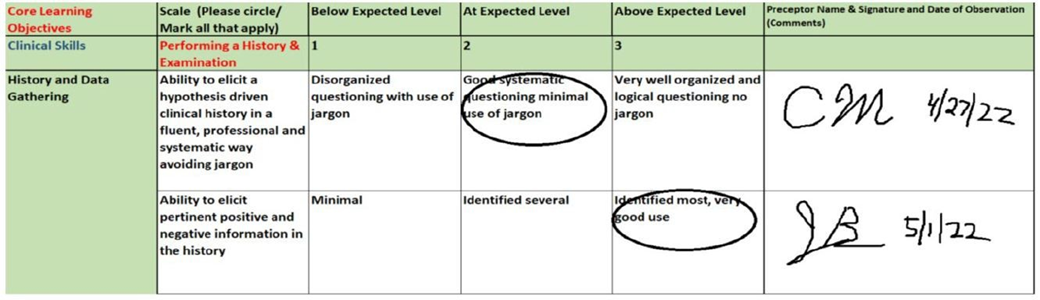
- Once an individual metric is observed, circle the appropriate skill level and sign and date the form in the comment section, as shown below:
Student Instructions
Students must:
- Download and print the IFF found on the clerkship’s learning management system and keep it available throughout the rotation.
- Coordinate with the preceptor to identify an appropriate patient for the observation.
- Give the IFF to the preceptor before the observed clinical encounter.
- Receive verbal feedback from the preceptor on the observed metric and have the preceptor circle the appropriate skill level, sign, and date each assessed metric. Metrics may be completed across different encounters and with different preceptors until the IFF is complete
- Save and upload jpeg images of the completed IFF to the Patient Encounter Log (PEL) for inclusion in the final evaluation system for the review by the clerkship director.
Number of Direct Observations to be Completed Using the IFF
Students in Internal Medicine and Surgery (12-week rotations) must submit two completed IFFs: the first before the Mid-Core Evaluation for formative feedback and the second before the final evaluation.
Students in Obstetrics and Gynecology, Pediatrics, and Psychiatry (6-week rotations) must submit one completed IFF.
Mid-Core Evaluation Requirement
Student evaluation occurs throughout each rotation, with the mid-point serving as an important opportunity to assess progress toward achieving learning objectives. The principal elements of mid-rotation feedback are the Mid-Core Examination, described in the preceding section, and the Mid-Core Evaluation.
Clinical faculty complete the Mid-Core Evaluation at approximately weeks 3–4 of a 6-week rotation and weeks 6–7 of a 12-week rotation. The evaluation involves an individual, face-to-face meeting to review the student’s performance and provide formative feedback.
Documentation of the meeting is submitted to the student's electronic record using the Mid-core Evaluation Form in the Clinical Evaluation System (ClinEval). The form, shown in Appendix E.2, provides clerkship directors with students’ performance data including:
- Patient Encounter Log (PEL) submissions
- AMBOSS quiz completion summary
- Mid-Core Examination score (if available)
Students also provide additional documentation of progress, including the IFFs, other quiz performance records, and clinical case write-ups, during the Mid-Core Evaluation.
The clerkship director conducting the evaluation is responsible for:
- Providing formative feedback on the student’s medical knowledge, clinical skills, and professionalism.
- Completing the electronic Mid-Core Evaluation Form in the ClinEval, including an appraisal of the student’s progress as satisfactory or unsatisfactory and constructive narrative comments.
- Providing narrative comments describing the deficiency whenever an evaluation component is rated as unsatisfactory. An unsatisfactory rating automatically results in referral of the student to their Clinical Academic Advisor from Clinical AADS to discuss the student's performance and develop a plan for improvement before the final evaluation.
The face-to-face Mid-Core Evaluation is designed to:
- Provide students with qualitative feedback early enough in the clerkship to address deficiencies.
- Help students recognize their strengths.
- Offer encouragement when performance is satisfactory and provide constructive guidance when improvement is needed
- Help students assess their progress and improve before the end of the rotation.
Comments documented during the Mid-Core Evaluation may be incorporated into the final evaluation.