
Overview of Mid-Core Examinations
The Mid-core Examination is administered at the midpoint of each core clerkship and the required Family Medicine/General Practice rotation. It provides faculty, academic advisors, and students with information about the student's progress toward competency in clinical subject knowledge.
The examination provides a snapshot of content mastery, helps identify students who may benefit from academic advising and targeted development, and supports students’ self-assessment and continued preparation for the higher-stakes NBME Clinical Subject Examination taken at the end of the clerkship.
Mid-Core Examination data are also reviewed by the Academic Promotion Review Committee (APRC) to identify students at risk of failing to meet program standards.
Required Exams
Students are required to take 6 Midcore Examinations as part of the assessment of clinical knowledge:
- One Mid-Core Examination for each core clerkship: Internal Medicine, Obstetrics and Gynecology, Pediatrics, Psychiatry, and Surgery
- One Mid-Core Examination for the Family Medicine/General Practice required rotation
Exam Schedule and Notification
The Mid-Core Examination is administered at the midpoint of the rotation:
- 6-week rotations: 4th Monday
- 12-week rotations: 6th Monday
Students are notified of exam details by SGU email from the Clinical Exam Team one week prior to the scheduled examination date.
Exam Structure, Delivery, and Feedback
Each Mid-Core Examination comprises 110 single-best-answer multiple-choice questions in 2 hours and 45 minutes without a break. Questions are developed by SOM clinical faculty based on the core's study schedule and the USMLE content outline, reviewed by the appropriate department chair, and tested for validity before being incorporated as a weighted examination item.
The Mid-Core Examination is delivered on the assessment solutions software ExamSoft, using technology-driven remote proctoring that digitally observes exam-takers with continuous video and audio monitoring throughout the exam session. Students receive a categorical feedback report through ExamSoft identifying areas of strength and opportunities for improvement. This feedback is intended to guide continued learning during the remainder of the clerkship.
Grading of Mid-Core Examination
The examination is graded using the Honors / High Pass / Pass / Fail system in accordance with percentiles established for the NBME Clinical Subject Examination and derived from the August 2024 cohort:
- Pass: ≥ 10th percentile
- High Pass: ≥ 50th percentile
- Honors: ≥ 75th percentile
Current Midcore Examination Score Cut-Points
| Core Rotation | Fail | Pass | High Pass | Honors |
| <10th percentile | 10th-49th percentile | 50th-74th percentile | >75th percentile | |
| Surgery | <54.5 | 54.5 | 64.5 | 72.5 |
| Internal Medicine | <54.5 | 54.5 | 68.5 | 74.5 |
| Obstetrics and Gynecology | <55.5 | 55.5 | 69.5 | 75.5 |
| Pediatrics | <53.5 | 53.5 | 68.5 | 74.5 |
| Psychiatry | <72.5 | 72.5 | 83.5 | 86.5 |
| Family Medicine | <49.5 | 49.5 | n/a | n/a |
Mid-Core Examination Failure
Students whose performance is below the 10th percentile are required to participate in academic advising meetings to identify areas of weakness and opportunities for improvement prior to the final NBME Clinical Subject Examination. Students below the 50th percentile are strongly encouraged to participate in academic advising.
Contribution to Final Clinical Evaluation
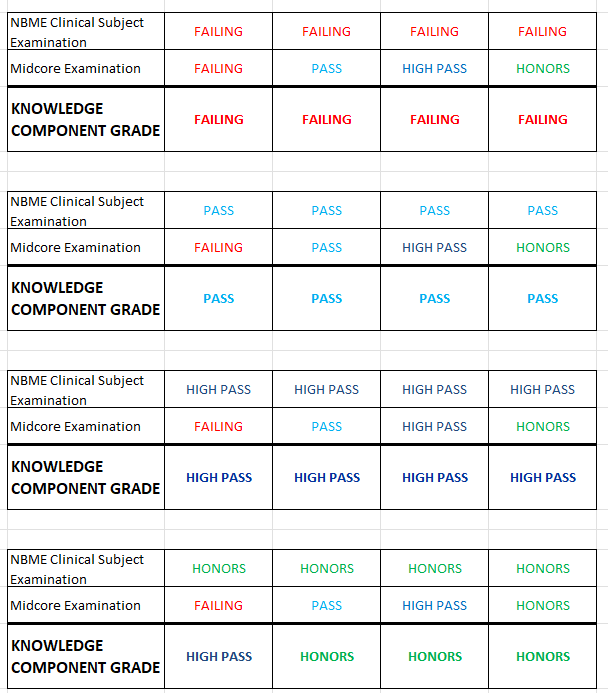
The Mid-Core Examination contributes approximately 20% to the assessment of the Knowledge Component of the final clinical evaluation for each core clerkship and the required Family Medicine/General Practice rotation. However, a failing score on the end-of-rotation NBME Clinical Subject Examination results in failure of the Knowledge Component, regardless of performance on the Midcore Examination.
Knowledge Component Grade
The table below shows the grading rubric used to determine the Knowledge Component grade based on performance on the NBME Clinical Subject Examination and the Midcore Examination. In general, the Knowledge Component grade corresponds to the student’s performance level on the NBME Clinical Subject Examination. However, if a student earns an Honors on the NBME Clinical Subject Examination but fails the Midcore Examination, the Knowledge Component grade is reduced to High Pass.
Table: Knowledge Component Grade Determination
Students who fail only the Knowledge Component will earn an “I” as the final grade for the evaluation and have the opportunity to remediate as per the grading system described in this Manual. Students who fail 2 or more evaluation components will earn a failing grade for the rotation.
Students should consult the Grading System and the Implications for Academic Progress sections of this Manual for detailed descriptions of the grading system, remediation, and academic progress.