
1. Mission and Introduction
The mission of the Department of Surgery is to:
- Provide a Surgical curriculum that applies consistently to all clerkship sites in order to include comparable educational experiences and equivalent methods of assessment across all instructional sites and to support a learning environment that fosters professional competence within a culture that prepares students for international medical practice.
- Emphasize, review and integrate the student’s knowledge of basic scientific information with clinical material to result in favorable educational outcomes in the acquisition of knowledge regarding the etiology, pathophysiology, diagnosis, treatment, and prevention of surgical diseases.
- Emphasize to the students the integration of the basic sciences in the development of current clinical knowledge in conjunction with ongoing changes in surgical treatment and technology.
- Provide students with the tools for life-long adult learning of surgical diseases for their ongoing professional development.
2. Guidelines
- Length: 12 weeks.
- General Surgery, for up to 8 weeks students, will be incorporated into a surgical team for a broad clinical experience. Students on surgery will also have dedicated education time. During these weeks student on-call experience is recommended. The specific on-call model will be at the discretion of the clerkship director, recognizing the balance between valuable clinical learning opportunities and students’ need for independent study time.
- The sub-specialty experience should be for 1 to 2 weeks for each component and may include Anesthesiology, Bariatric Surgery, Cardiothoracic Surgery, Emergency Medicine, Neurosurgery, Ophthalmology, Oral and Maxillofacial Surgery, Orthopedic Surgery, Otolaryngology, Pediatric Surgery, Plastic Surgery, Podiatry, Surgical Critical Care, Transplant Surgery, Trauma Surgery, Urology and Wound Care as well as other procedure oriented sub-specialties. The selection and time distribution of the associated sub-specialty experience will be at the discretion of the clerkship director.
- A specific formal orientation session at the start of the clerkship must be provided.
- The orientation must include the behavioral expectations for each student, including a discussion of professional behavior and interpersonal and communication skills, as well as an overview of the departmental organization and the facilities of the site.
- Student schedules must be provided as well as assignments to residency teams and preceptors. The Clinical Training Manual must be provided as a reference within the orientation process indicating the location on the SGUSOM website. A review of the Goals and Objectives, Clerkship Guidelines and evaluation process should be conducted.
- Inpatient, outpatient, and acute care experience should be provided.
- Attending rounds for house staff and students should be conducted at least three times a week.
- The clerkship must include a schedule of teaching conferences, both in conjunction with and in parallel to the educational opportunities of the residents/registrars, including grand rounds, subspecialty conferences and didactic sessions that address the Core topics of the Clinical Training Manual. Students should be encouraged to study at least 3 hours every evening and at least 8 hours on weekend days off.
- There should be direct preceptor supervision of the students at least three hours per week with case presentations by the students and bedside rounds, including physical examination and interactive sessions.
- The Standard Departmental Examination format and cases that are distributed at each clinical meeting may be used for teaching as well as for formative and summative feedback, particularly in the assessment of clinical reasoning, problem solving, and communication skills.
- A sufficient number of comprehensive write-ups are required over the course of the clerkship to ensure student competency in documentation of a comprehensive history and physical exam. The “Patient Encounter Template” that is distributed at each faculty meeting is based on the USMLE Step 2 examination and is recommended. The exercise should be structured to address the development of clinical skills through a defined problem solving approach with data gathering based on: 1) clinical history, 2) physical examination and 3) laboratory, imaging and other ancillary studies in order to develop: 4) a rank-order differential diagnosis list and concluding with 5) a primary working diagnosis to discuss with the patient and will direct treatment, prognosis and/or further investigation. Formative feedback on the exercise must be part of the process. Oral presentations are also required and student competency in their ability to present pertinent findings during rounds and preceptor sessions is assessed.
- Electronic patient encounter logs are to be maintained and up to date at all times.
- Electronic patient logs should be periodically inspected by the clerkship director and at mid-rotation in order to monitor the types of patients or clinical conditions that students encounter and modify them as necessary to ensure that the objectives of the education program are met. The patient logs may also be used by the Dean and the Chair of Surgery in order to monitor the types of patients or clinical conditions that students encounter in order to determine if the objectives of the medical education program are being met.
- Students are responsible for the review of basic anatomy, pathology, and physiology of all surgical problems encountered.
- The Department of Surgery is responsible to teach and assess competency in starting an intravenous line and venipuncture.
- In addition to formative feedback given within the daily progress of the 12-week rotation, a defined formative feedback session must be provided by the clerkship director (or their designate) at the approximate mid-point of the clerkship.
- The patient encounter log should be reviewed at the time of the mid-core session. The mid-core feedback session must be a one-on-one session with each student with completion of the standard form, signed by both the clerkship director and the student.
- Summative evaluation of each student will include the administration of an end-of-core written examination in the form of the National Board of Medical Examiners Clinical Subject Examination in Surgery.
- In addition to formative feedback given over the course of the 12-week rotation, a defined summative feedback session must be provided by the clerkship director (or their designate) at the conclusion of the clerkship.
3. Educational Objectives
Medical Knowledge
- Discuss the presentation and treatment of diseases that are commonly addressed within the field of surgery.
- Identify how and when evidence-based information and other aspects of practice-based learning and improvement affect the care of the surgical patient and the alternatives in management.
- Discuss cost to benefit ratio, the role of payment and financing in the healthcare system, the role of multi-disciplinary care including ancillary services such as home-care and rehabilitation and other aspects of systems-based practice in the implementation of the available technologies used in surgical treatment.
- Demonstrate understanding of the Core Topics (modules listed below) and its application to associated surgical knowledge in clinical analysis and problem solving.
- Utilize distributive learning through the use of on-line resources for surgical learning and problem-solving.
Clinical Skills
- Apply the principles of surgical practice, including operative and non-operative management to common conditions.
- Apply the tools of clinical problem solving for surgical conditions including the process of data collection (history, physical examination and laboratory and imaging studies) in establishing a list of differential diagnoses and a primary working diagnosis for treatment and further investigation.
- Identify the importance of and approach to informed consent for surgical operations and procedures, with emphasis on the risks, benefits, and alternatives.
- Demonstrate application of interpersonal and communication skills in the multidisciplinary care of the surgical patient in an environment of mutual respect.
- Demonstrate the ability to conduct proper sterile preparation and technique.
Professional Behavior
- Function as a part of the surgical care team in the inpatient and outpatient setting.
- Demonstrate proper behavior in the procedural setting, including the operating room, at all times.
- Recognize the limits of one’s position within the surgical care team in order to appropriately engage each patient, their friends and associates and their family.
- Appropriately seek supervision as provided through the hierarchical structure of the surgical care team.
- Identify and respond sensitively to cultural issues that affect surgical decision-making and treatment
- Develop an understanding of and approach to the principles of professionalism as they apply to surgery through the observation of the role-modeling provided by the surgical faculty.
- Demonstrate responsibility and compliance by fulfilling rotation expectations and participating in all required learning activities.
4. Core Topics
- Shock
- Trauma
- Head Injuries
- Burns
- Acute Abdomen
- Intestinal Obstruction
- Gastrointestinal Hemorrhage
- Common Gastrointestinal and Cutaneous Malignancies
- Hernias
- Surgery of the Breast
- Benign Colo-rectal Disorders
- Peripheral Arterial Disease
- Venous Disease
- Thoracic Surgery
- Transplant Surgery
- Laparoscopic Surgery
- Bariatric Surgery
- Endocrine Surgery
- Ethical and Legal Issues in Surgery
- “Futile” care
- Organ procurement
- Transplantation guidelines
- Withholding or withdrawing care
- HIV testing
- Referral of patients
- Confidentiality
- Fee splitting
- Informed consent
- Substitution of surgeon
- Disputes between medical supervisors and trainees
- New medical and surgical procedures
- Surgery in the Elderly
- Communication Skills in Surgery
- Surgical Subspecialties
- Anesthesiology
- Orthopedics
- Urology
- Ophthalmology
- Otorhinolaryngology
5. Required Clinical Encounters and the Patient Encounter Log
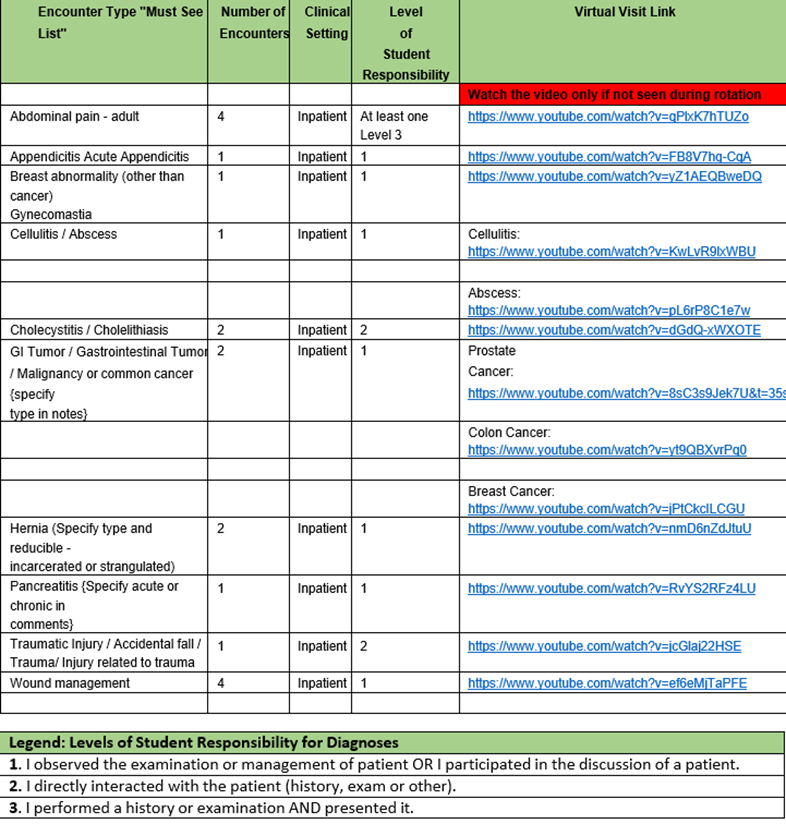
The faculty in each specialty have identified specific clinical experiences that are a requirement for the clerkship. The PEL program is designed to track each student’s patient encounters, clinical setting in which the encounter occurs, and level of responsibility. This program allows the school to standardize the curriculum. All patient’s complaints and/or diagnosis encountered during clinical rotations must be entered into the PEL program. Entering the required clinical encounters “Must See List” is required during clinical rotations and will be displayed to the clerkship director for review on the final clerkship evaluation. Whenever possible incorporate the Communication Skill course topic for each required encounter. Never place patients’ names or any patient identifying information in this program, this would be a HIPPA violation.
If students are unable to see a required clinical encounter, they must view the virtual visit link and watch the video. Once the encounter video is viewed, add the virtual encounter in the PEL as a Virtual visit.
The entries for the list of complaints and diagnoses below must be entered into your Patient Encounter Log (PEL) application during this clerkship.
PEL Link: https://myapps.sgu.edu/PEL/Admin/Account/Login?ReturnUrl=%2fPEL
6. Web-based Educational Assignments for Independent Learning
The School requires the successful completion of web-based assignments in order to receive credit for this clerkship. Students should log into the learning management system and complete the following:
- SGUSOM's curriculum on AMBOSS
- UWorld
- Communication Modules
- Ethics Modules
- Geriatrics
The Office of the Dean monitors student performance on these assignments. The completion of these assignments will be sent to the clerkship directors for incorporation into the final clerkship grade. The clinical faculty feels these assignments are excellent preparation for the NBME Clinical Subject Examinations as well as USMLE Step 2. In addition, a student’s diligence in completing these assignments reflects a commitment to excellence, a component of professional behavior grade.
7. Reading
Required Texts
- Essentials of General Surgery and Surgical Specialties, Lawrence, Williams and Wilkins
Recommended Texts
- Code of Medical Ethics: Current Opinions with Annotations, AMA press
- Early Diagnosis of the Acute Abdomen, Cope, Oxford University Press
- Essentials of Diagnosis and Treatment in Surgery (Lange Current Essentials Series)
- The Ethics of Surgical Practice: Cases, Dilemmas and Resolutions, Jones, McCullough, and Richman, Oxford University Press
- Ellis and Calne's Lecture Notes in General Surgery, Watson and Davies, Blackwell
- Principles of Surgery, Schwartz, McGraw Hill
- The ICU Book, Marino, Williams and Wilkins
Journals
- Journal of the American College of Surgeons, Elsevier
- British Journal of Surgery, Wiley-Blackwell
Surgical Organizations
- Student membership in the American College of Surgeons is available through FACS.org, with the support of the Chair of Surgery, and is a well-developed source of educational material for the study of surgery.