
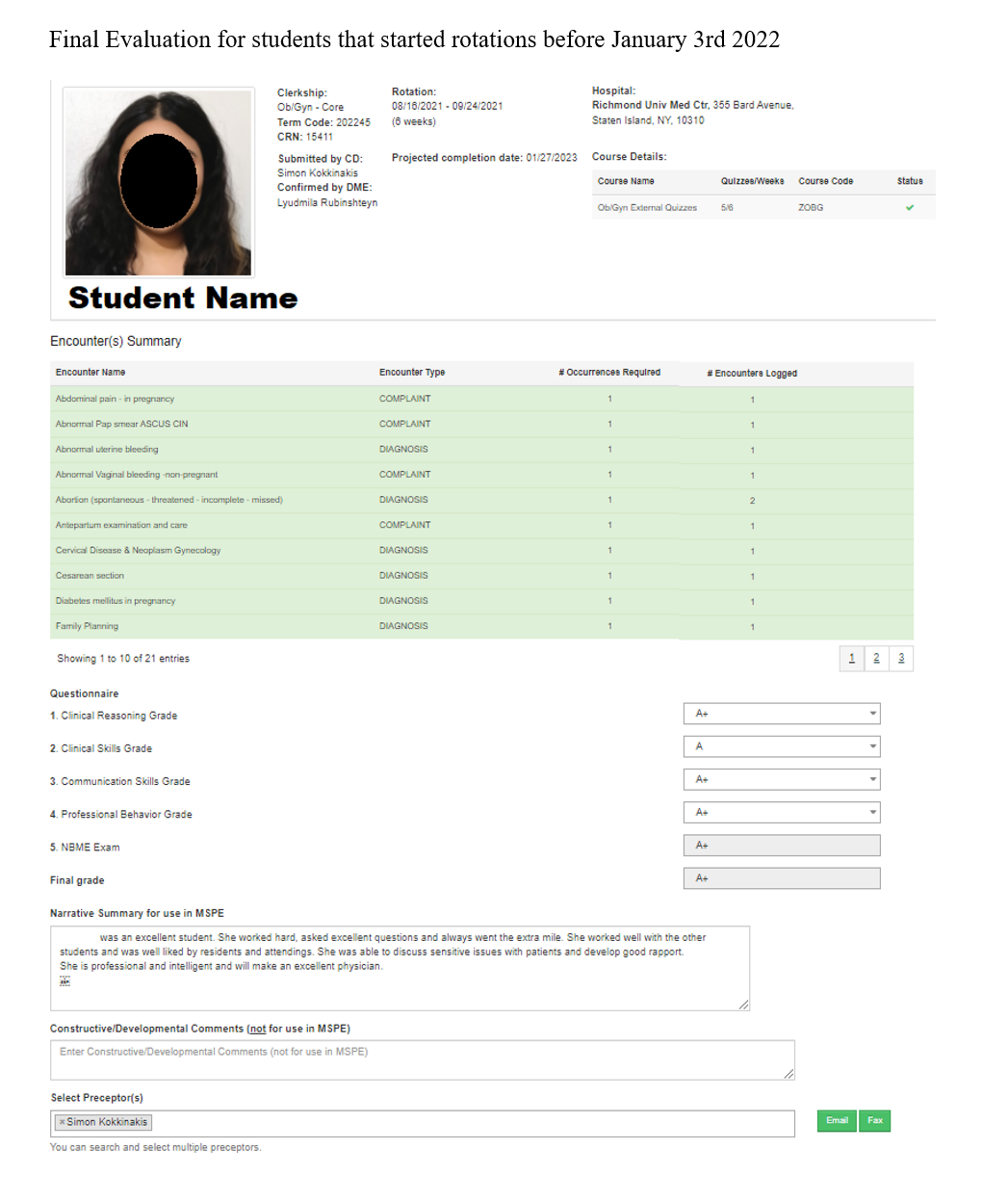
Grading System for Students Who Started Their Core Clerkships (Year 3) Before January 3, 2022
The final grade in the clerkship comprises 5 components:
- Clinical Reasoning: 20%
- Clinical Skills: 20%
- Professional Behavior: 20%
- Communication Skills: 10%
- NBME Clinical Subject Exam Grade: 30%
Items one through four reflect subjective faculty assessments at the hospital.
Students take the NBME Clinical Subject Examination during the final 2 weeks of their clerkship. The Office of Clinical Education Operations receives the scores from these examinations, and scores are automatically uploaded to the SOM Clinical Evaluation System.
The NBME Clinical Subject Exams are graded as follows:
| Score | Grade |
| 75 or greater | A+ (Honors) |
| 70 - 74 | A |
| 65 - 69 | B |
| 60 - 64 | C |
| 59 or below | F |
The electronic evaluation automatically determines the final grade based on the clerkship director's grades of the individual components plus the NBME Clinical Subject Examination grade. Depending on the grades on other evaluation components, it is possible for students who fail the NBME Clinical Subject Examination but pass the other components of the clerkship to earn a passing grade for the clerkship. This grade is final. Even after repeating and passing the NBME Clinical Subject Examination, the grade is not changed.
In such cases repeating the clerkship is not necessary; the School gives students credit for the clerkship. However, the Graduation Assessment Board does not approve this student for graduation until the student demonstrates competency in the relevant subject area by passing the make-up of the failed NBME Clinical Subject Examination after additional study time to improve medical knowledge and test-taking skills.
Since performance on the NBME Clinical Subject Examination correlates with performance on USMLE Step 2, students who perform poorly on the NBME Clinical Subject Examinations (failing or persistent low scores) should consider a structured program during their fourth year to improve their medical knowledge and test-taking skills. A student may pass the NBME Clinical Subject Examination but fail another individual component of the clerkship such as communication skills or professional behavior. In such a case, if the final grade is passing, the School gives the student credit for the clerkship, but the student should work to remediate these deficiencies during subsequent rotations to achieve the desired level of competency in the particular component(s).
Definition of Grades
| Grade | Definition |
| A+ (Honors) | requires all As and an A+ on the NBME Clinical Subject Examination. A+ (Honors) must be given to students with these grades. |
| A | is given to students who proficiently develop the competencies listed in the Clinical Training Manual and whose overall performance is good. |
| B | is given to those students who only adequately develop the required competencies and whose overall performance is acceptable. |
| C | is given to those students who barely meet minimum requirements. This grade is a "warning" grade and identifies a student who is struggling in medical school and requires additional mandated training and/or counseling. |
| F | is given to those students whose continuation in medical school is problematic. An "F" in any component of the assessment precludes a student from meeting graduation requirements until the GAB determines that the student has reached the required level of competency in that component(s). A final grade of F leads to a recommendation for dismissal from medical school. |
| NG | A clerkship director may report a "No Grade" for a student who is registered in a course. Students must fulfill all course requirements as defined by the clerkship. Once all requirements have been completed, the NG converts to a final grade. Failure to complete remaining requirements within the required timeframe as outlined in the CTM results in an "F" grade for the clerkship. |
| I | is given when additional clinical work/remediation is required to complete the course. The "I" designation remains on the transcript until a final course grade is given upon completion of remaining course requirements. |
Clerkship directors have the option of adding + or - to the above grades based on their opinion. Only grades of A+ require objective criteria.
In summary, grading of student performance should use the following:
- A+ = exceptional
- A = good
- B = adequate
- C = minimal
- F = failing
Components of the Assessment
Clinical Performance
The teaching physicians who work with the student during the rotation assess the student's clinical performance in four areas clinical reasoning, clinical skills, communication, and professional behavior (Appendix M). The more feedback the clerkship director gets from different members of the medical staff that instructed the student, the more objective grades can be. The faculty assesses the extent to which the student has developed the competencies required for that rotation. These specific competencies appear in Section Nine of this Manual in the curriculum for each of the core clerkships.
The NBME Clinical Subject Examination at the End-of-Clerkships
The NBME Clinical Subject Examination must be taken by all students during the final 2 weeks of the clerkship. Scheduling for this exam is done by the Office of Clinical Education Operations - Clinical Examination Team. Students who test at Prometric Centers receive permits at least three weeks prior to each exam. Hospitals must excuse students one day before the pediatrics, family medicine, obstetrics and gynecology and psychiatry exams for study time and two days before the medicine and surgery exam for study time. Students are excused for the entire day of the exam.
Clinical experience during the rotation does not provide adequate preparation for the NBME Clinical Subject Examination. Students must use UWorld and AMBOSS and other recommended resources for each clerkship to prepare for these exams. Students can find the content outline of these exams on the NBME website. Students must sit the NBME Clinical Subject Examination before starting their next rotation.
- All students must attend the NBME Clinical Subject Examination as scheduled.
- Students who are too ill to take the exam as scheduled should refer to the "Medical Excuse" policy in the Student Manual.
- Failure to take the NBME Clinical Subject Examination on time constitutes a failure to complete required clerkship components and results in a failing grade for the clerkship.
- Students who earn a failing grade in a clerkship must repeat and pass the clerkship to meet graduation requirements.
- Any student who fails an NBME Clinical Subject Examination must remediate knowledge deficiencies and retake and pass the failed subject exam.
- Passing all 6 NBME Clinical Subject Examinations (Internal Medicine, Surgery, Pediatrics, Obstetrics and Gynecology, Psychiatry, and Family Medicine) is a graduation requirement.
- For students who have not yet completed all required core clerkships (Year 3), any failed NBME Clinical Subject Examinations must be retaken and passed prior to starting fourth-year electives.
- For students who have completed all required core clerkships (currently in Year 4), all failed NBME Clinical Subject Examinations must be re-taken and passed by the end of the fourth year.
- Students intending to schedule re-take exams must contact clinicalexam@sgu.edu for instructions on how to schedule this exam. Retake exams must be scheduled at least 4 weeks prior to the intended exam date.
- Students should plan their schedules accordingly and consult their academic advisor for guidance on planned remediation and scheduling retake exams.
- A 3-week remediation period for each failed NBME Clinical Subject Examination is strongly recommended followed by the required retake of the failed exam. This may be taken in the form of bridge time or an LOA.
- A GAB elective in the failed subject is no longer a requirement for remediation of failed NBME Clinical Subject Examinations. Students who have already scheduled these electives may take the elective as planned or arrange for an alternate elective. Students should contact their clinical student administrator for any changes to scheduled electives.
Implications for Academic Progress
The final grade for the core clerkship is determined by grades earned for each of the 5 components.
- Students must successfully complete all core clerkship/Family Medicine/General Practice (FM/GP) requirements and pass each core clerkship/required rotation/elective.
- Students who do not complete required clerkship components by the scheduled end of a clerkship (and are not on an approved LOA) earn a failing grade for the clerkship. An approved clinical/medical excuse is required for students to delay the NBME Clinical Subject Examination at the end of clerkship. Note: only one clinical/medical excuse is permitted per year.
- Students with a failing grade for the core clerkship/FM/GP required rotation are required to repeat the clerkship/rotation in order to remediate academic deficiencies and earn a second grade for the clerkship.
- Students are permitted only one failure during the clinical studies phase of the curriculum. Students with a second failing grade in the clinical terms are recommended for dismissal. Any student recommended for dismissal is given the opportunity to appeal to the CAPPS.
- Students must make progress toward completing the MD Program withing the 6-year maximum allowable timeline. Students unlikely to complete requirements within the maximum allowable timeline are recommended for dismissal.