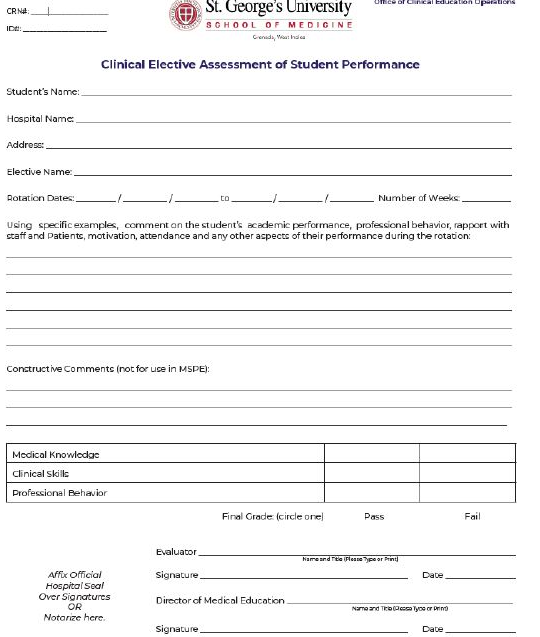
For elective rotations starting as of Jan 1, 2026
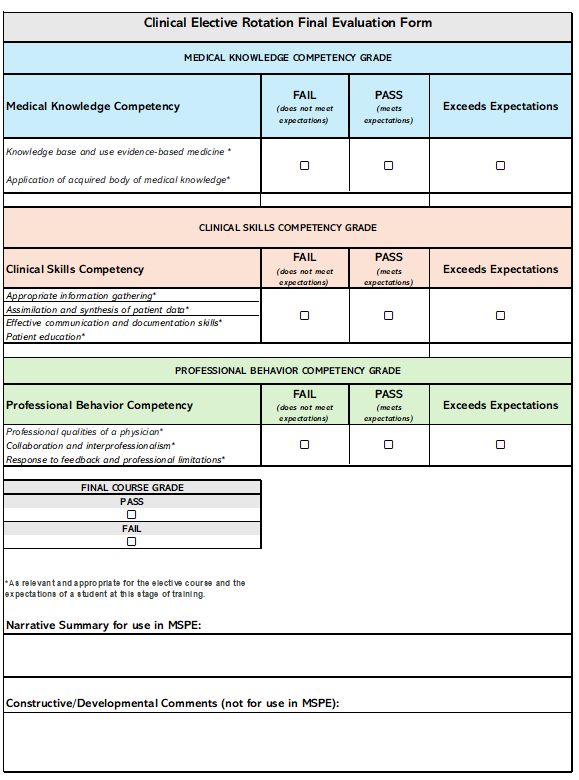
Clinical Elective Rotation Final Evaluation Form - Grading Rubric
Clinical Elective Rotation Final Evaluation Form | |||
| As relevant and appropriate for the course and the expectations of a student at this stage of training. | |||
| Medical Knowledge Competency | Does not meet expectations | Meets expectations | Exceeds expectations |
| Demonstrates the ability to effectively develop a knowledge base and use evidence-based medicine to evaluate patient presentations | Unable to recognize own knowledge gaps and inconsistently demonstrates expansion of knowledge base. Does not seek out evidence- based medicine resources or relies solely on clinical decision support sources | Consistently shows dedication to expanding own knowledge base recognizes own knowledge gaps. Seeks out evidence-based medicine resources including clinical decision support materials and peer-reviewed guidelines. | Consistently demonstrates expansion of knowledge base and proactively rectifies own knowledge gaps. Seeks out evidence-based medicine resources from all available sources and consistently assesses primary literature as applicable |
| Demonstrates application of acquired body of medical knowledge and disease pathophysiology and effects of individual bio-psycho-sociocultural factors, to clinical problem solving and patient care. | Poor knowledge base and/or understanding of disease pathophysiology and effects of individual bio-psycho-sociocultural factors. Inconsistent ability to apply knowledge in clinical situations | Adequate knowledge base and/or understanding of disease pathophysiology and effects of individual bio-psycho-sociocultural factors. Consistent ability to apply knowledge in clinical situations | Exceptional knowledge base and/or understanding of disease pathophysiology and effects of individual bio-psycho-sociocultural factors. Consistent ability to appropriately apply knowledge in a manner tailored for each clinical situation |
| Clinical Skills Competency | Does not meet expectations | Meets expectations | Exceeds expectations |
| Demonstrates the ability to gather appropriate information, including the examinations/evaluations/procedures necessary to develop treatment and therapeutic plans (as relevant and appropriate) | Inconsistently or inaccurately gathers appropriate information and/or performs accurate physical/mental status exams as needed. Inconsistently able to use gathered information to develop reasonable plan. Not adequately prepared to help during procedures. | Consistently and accurately gathers appropriate information in an organized, logical manner and performs accurate physical/mental status exams as needed. Consistently uses gathered information to develop reasonable plan. Appropriate preparation and execution of procedures as appropriate for simple to medium complex patients. | Consistently and accurately gathers appropriate information even in complex situations. Performs accurate physical/mental status exams and is able to broaden or narrow depending on individual cases. Uses information gathered to develop comprehensive plans. Aware of which procedures would be useful in developing plan and fully prepared to perform them as appropriate. |
| Effectively assimilates and synthesizes patient data to generate a differential diagnosis, and apply current scientific data, guidelines, and standards to patient care. | Generates limited differential diagnosis. Inconsistently develops or modifies treatment plans. Inconsistently applies evidence-based medicine to patient care or only with prompting struggles on simple medical to moderate cases and does not seek advice when needed. | Generates a reasonable and appropriate differential diagnosis. Consistently modifies plan based on patient's clinical course and additional data. Able to support assessment and plan with evidence-based medicine. Seeks advice appropriately | Generates a complete, relevant, and prioritized differential diagnosis. Proactively modifies plan and anticipates next steps. Consistently seeks out primary sources to support assessment and plan with evidence-based medicine. Seeks advice appropriately |
| Demonstrates effective communication and documentation skills, including those required for coordination and transition of care and recognition of patients requiring escalation of care and additional evaluation. | Inconsistently or inaccurately communicates. Illogical documentation lacking key elements. Inconsistently recognizes or prioritizes care in urgent and emergent situations | Communicates effectively. Logical documentation containing key required elements. Consistently recognizes and prioritizes care in urgent and emergent situations | Communicates comprehensively and proactively. Easy to follow logical documentation, including all desired elements. Consistently recognizes urgent and emergent situations and attempts to formulate robust management plans for situation |
| As relevant and appropriate, educates patients on illness and plan of care without the use of medical jargon while assessing patient understanding | Inconsistently establishes therapeutic relationships with patients and families. Not always able to clearly explain current illness and management plan without the use of medical jargon. Inconsistently assesses patient understanding | Establishes a therapeutic relationship with patients and families. Clearly explains current illness and management plan without the use of medical jargon. Consistently assesses patient understanding. Recognizes barriers to compliance. | Easily establishes therapeutic relationships with patients and families, even in challenging situations. Proactively seeks out patient education opportunities. Avoids medical jargon. Incorporates patient’s own needs and values in relationship and consistently checks understanding. Recognizes barriers to compliance and offer novel solutions. |
| Professional Behavior Competency | Does not meet expectations | Meets expectations | Exceeds expectations |
| Demonstrates the professional qualities expected of a physician, including commitment to honesty, integrity, respect for others, the value of diversity, and personal accountability. | Does not consistently demonstrate integrity, respect and honesty. Does not always take responsibility for own actions. Inconsistently instills a sense of trust. Inconsistently demonstrates the ethical principles of a physician. Does not consistently adhere to principles of patient confidentiality. Does not consistently display sensitivity to needs of diverse patient populations. | Consistently demonstrates integrity, respect and honesty. Consistently demonstrates accountability for own actions and instills trust in others. Committed to upholding ethical principles of a physician and consistently adheres to principles of patient confidentiality. Displays sensitivity to needs of diverse patient populations. | Advocates for integrity and respect in complex situations. Consistently demonstrates personal accountability and always instills trust in others. Always demonstrates commitment to upholding ethical principles of a physician. Always adheres to principles of patient confidentiality. Identifies needs of diverse patient populations and apply individualized approaches to care. |
| Collaborates effectively as a member of an interprofessional team to coordinate patient care within the larger context and system of health care | Inconsistently or inaccurately communicates with team members to coordinate patient care. Unaware of roles of other health professionals. Inconsistently demonstrates respect for other members of the health care team. Considers effective utilization of resources and patient safety only with prompting. | Consistently communicates and collaborates with team members to coordinate patient care. Aware of roles of other health professionals and demonstrates respect for the other members of the health care team. Considers effective utilization of resources and patient safety. | Proactively communicates and collaborates with team members to coordinate patient care. Proactively partners with other health professionals to leverage their expertise in providing best care for the patient. Consistently demonstrates respect for the other members of the health care team. Always considers effective utilization of resources and advocates for patient safety. |
| Identifies areas for personal and professional improvement, responds appropriately to and assimilates feedback on performance, and recognizes own limitations and when to ask for help. | Unable to identify areas for improvement. Not always able to manage competing personal and professional responsibilities. Does not consistently incorporate feedback into practice. May display difficulty in accepting feedback. Unaware of when to ask for help. | Identifies own areas for improvement. Demonstrates ability to manage competing personal and professional responsibilities. Receives feedback well and incorporates into practice. Aware of when to ask for help. | Independently identifies areas for improvement and works to fill any gaps in performance. Demonstrates ability to manage competing personal and professional responsibilities proactively. Seeks feedback and immediately incorporates suggestions into practice. Always aware of when and how to ask for help. |
For elective rotations ending by December 31, 2025